

X
The Sales Nerd
GTM Framework
The exact lifecycle, pipeline, and attribution model we use to design scalable revenue systems.

SaaS companies rarely struggle due to lack of tooling — they struggle because their RevOps engine was built out of sequence. This article explores the architectural order that allows lifecycle clarity, reporting trust, optimization confidence, and ultimately AI readiness to compound.
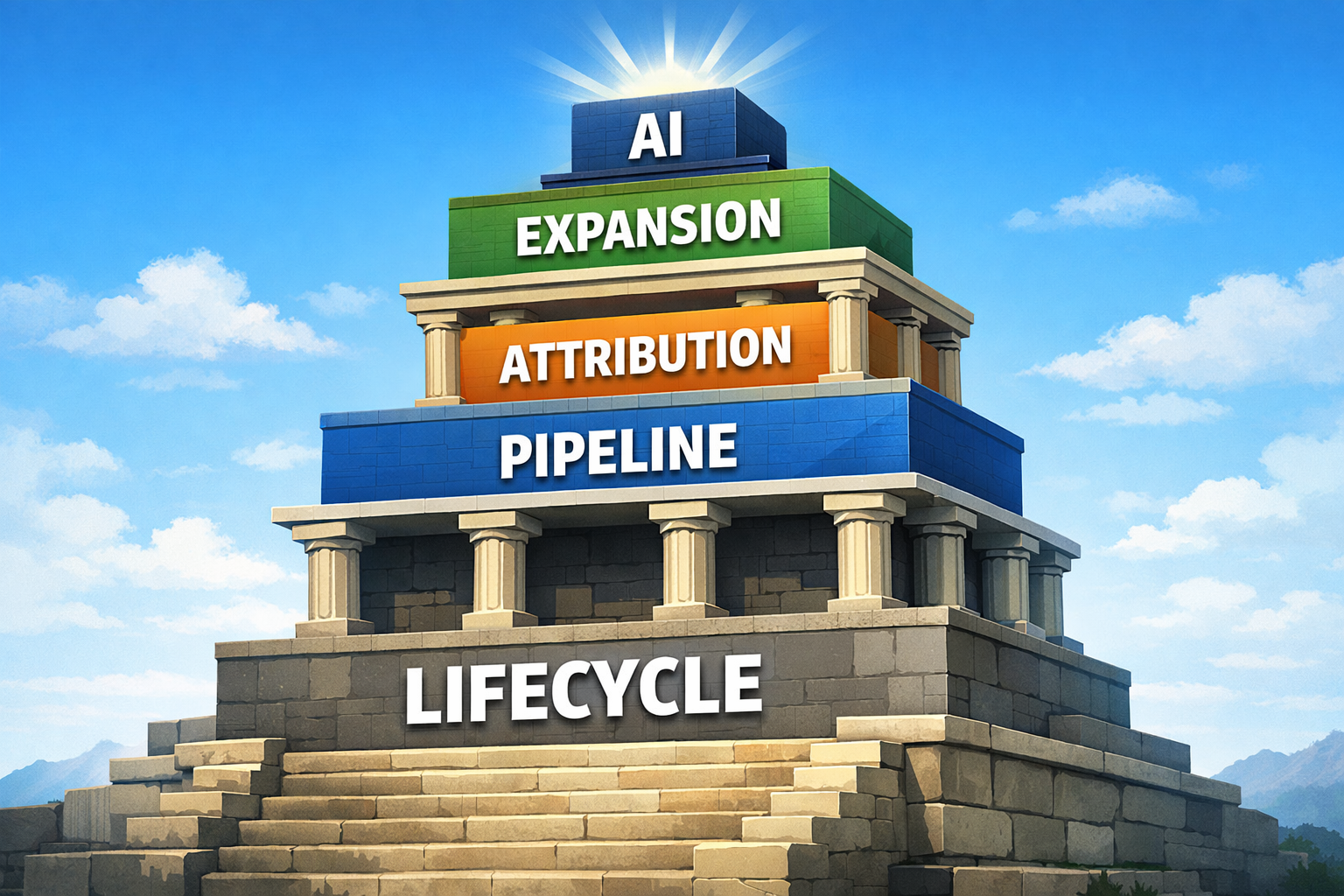
One of the most consistent patterns across SaaS companies isn’t lack of investment in RevOps. It’s lack of sequencing different environments to paint a picture.
By the time most teams reach the $25M–$100M ARR range, they are not short on systems. CRM is in place. Marketing automation exists. Routing tools, enrichment providers, analytics layers, product telemetry, customer success platforms — the environment is already dense.
What feels missing is coherence.
Reporting debates continue despite dashboards multiplying. Attribution models change quarterly without gaining credibility. Lifecycle definitions drift between teams. AI pilots emerge, show promise, and quietly stall. Leaders sense the infrastructure should be producing clarity, yet it often produces interpretation. The concrete results teams purchased tools for remains adrift.
The underlying issue is rarely capability. It is order.
RevOps is not a collection of systems. It is an operating model expressed through systems. And operating models, like architecture, compound when constructed in sequence and destabilize when assembled opportunistically. This is the same that I'm seeing with AI use - it's tactical instead of being systematic.
Across engagements at The Sales Nerd and over my career a clear pattern emerges in how durable RevOps environments take shape.
Not quickly. Not perfectly. But consistently in order.
The earliest structural decision inside a RevOps engine is lifecycle. What are the Lifecycle Stages? What are their definitions? When we say conversion rate, what are we referring to as steps?
This often feels deceptively simple because most organizations already have lifecycle stages defined somewhere. The challenge is not existence; it is agreement, instrumentation, and behavioral adoption.
Lifecycle answers a foundational question: where is a person or account in their relationship with the business?
Without that shared context, downstream processes become interpretive. Sales believes leads are unqualified (MQL to SAL/SQL conversion). Marketing believes engagement is strong (Quantity of MQL's). Customer success believes expansion readiness is unclear (Due to lack of expansion definitions in the lifecycle). Executives observe conversion rates without confidence in stage integrity or reasoning.
When lifecycle is architected intentionally — with entry criteria, exit criteria, ownership clarity, and automation consistency — it becomes the relational spine of the revenue model. Conversion steps become clear and purposeful and you can begin to compare cohorts.
Skipping lifecycle rarely looks like an explicit decision. It looks like teams moving forward.
But forward without lifecycle clarity is forward without shared narrative.
Once lifecycle establishes relational context at a Contact and Account Level, pipeline becomes the operational expression of value creation.
Pipeline often receives disproportionate attention early because it is the most visible revenue artifact. Forecast calls, stage definitions, deal inspection, and conversion analysis all concentrate here. Yet pipeline absent lifecycle frequently becomes overloaded with meaning it cannot carry.
Opportunities begin representing qualification, intent, engagement, account maturity, and commercial readiness simultaneously. Stage definitions blur between activity and outcome. Conversion rates fluctuate without clear causal interpretation.
When lifecycle precedes pipeline, opportunity architecture simplifies, but it's not completely necessary. Often companies focus immediately on the Sales Process and then realize they need better controla nd measurement over Opportunity Creation - where the Lifecycle Stages do most of their heavy lifting.
Pipeline reflects commercial progression within lifecycle context rather than attempting to encode the entire relationship. Qualification lives upstream. Engagement lives upstream. Account readiness lives upstream.
This separation is subtle but stabilizing. It reduces stage proliferation, clarifies reporting interpretation, and improves forecast confidence because the pipeline model is no longer compensating for upstream ambiguity.
Pipeline works best when it is not asked to explain everything.
Once lifecycle and pipeline are stable, marketing attribution and marketing operations can finally become operational rather than aspirational.
Most SaaS companies pursue attribution early because leadership wants clarity on marketing impact. The motivation is valid, but without lifecycle consistency and well-defined pipeline entry, attribution models end up measuring activity rather than contribution.
Touch points accumulate. Campaign responses increase. Engagement dashboards expand. Yet the connection to meaningful commercial progression remains unclear.
Across many client environments, the most durable attribution approach is also the simplest: first-touch and last-touch models.
Not because they are theoretically complete, but because they are operationally interpretable.
First-touch provides origin context — how demand entered the system. Last-touch provides conversion context — what influenced immediate progression. Together, they create a practical narrative of demand creation and demand capture that teams can understand and act on.
More complex multi-touch models often introduce sophistication faster than trust. Without stable lifecycle transitions and clear pipeline creation rules, weighted attribution can quickly become a debate artifact rather than a decision-making tool.
When lifecycle definitions are trusted and pipeline reflects discrete commercial motion, even simple attribution models become powerful.
Marketing operations can then focus on connecting programs to stage movement, opportunity creation, and pipeline acceleration. Attribution stops being a reporting exercise and becomes a progression measurement layer.
This is typically where marketing operations maturity accelerates more broadly. Campaign architecture, source taxonomy, scoring logic, routing workflows, and nurture design begin operating against a stable system of record rather than compensating for structural ambiguity.
The shift is noticeable in how marketing conversations evolve.
Instead of asking, “How many responses did this generate?” teams begin asking, “Did this create pipeline or help convert it?”
Attribution becomes less about perfect credit distribution and more about credible signal that informs investment decisions.
Marketing operations, in turn, transitions from campaign execution infrastructure to progression instrumentation infrastructure.
This layer rarely stabilizes before lifecycle and pipeline. But once those foundations exist, attribution and marketing operations often become one of the fastest areas of RevOps maturity — precisely because they finally have something stable to measure.
A subtle but consequential shift occurs when lifecycle extends beyond closed-won.
Expansion stops being treated as a separate operating model and instead becomes continuation.
In many SaaS environments, post-sale infrastructure evolves independently. Customer success tools operate adjacent to CRM. Expansion opportunities are inconsistently modeled. Account health signals exist but lack structural connection to commercial workflows.
This fragmentation obscures one of the most important realities of SaaS economics: growth is longitudinal.
When lifecycle persists across acquisition and customer phases, expansion inherits architecture. Pipeline patterns can be reused. Attribution can extend. Reporting can unify. Account strategy can be contextualized across time rather than reset at sale.
Expansion modeling becomes less about introducing new structure and more about extending existing structure.
This continuity is rarely accidental. It emerges when lifecycle was designed with persistence in mind from the beginning.
By the time organizations begin asking optimization questions — which programs to scale, which segments convert, where resources should shift — they are implicitly expressing trust expectations.
Optimization is decision-making.
Decision-making requires signal integrity.
If lifecycle transitions are inconsistent, pipeline definitions drift, attribution credibility fluctuates, or expansion modeling is partial, optimization conversations become cautious. Leaders sense data exists but hesitate to act on it decisively.
When preceding layers are stable, optimization becomes natural. Experimentation cycles accelerate. Budget allocation conversations simplify. Operational hypotheses become testable within reliable measurement frameworks.
Optimization is not a capability unlocked by tooling. It is a behavior unlocked by confidence.
Confidence compounds from sequence.
AI now appears across nearly every RevOps conversation.
Summarization, scoring, personalization, forecasting augmentation, anomaly detection — the application surface is expanding quickly. Yet a quiet pattern accompanies AI exploration inside revenue organizations.
AI amplifies whatever environment it inherits.
When underlying architecture is coherent, AI surfaces insight faster, automates responsibly, and enhances decision velocity. When architecture is fragmented, AI accelerates inconsistency, reinforces ambiguity, and produces outputs that feel impressive yet operationally unusable.
The disappointment many teams experience with early AI initiatives is not technological. It is architectural.
AI depends on structured context, consistent state transitions, unified identity models, and trustworthy signal lineage. These are outcomes of lifecycle, pipeline, attribution, and expansion sequencing.
AI readiness is therefore less about adopting AI tools and more about inheriting architectural maturity.
The organizations deriving the most value from AI are rarely those experimenting the earliest. They are those whose RevOps engines were already coherent.
AI becomes multiplier rather than compensator.
Seen individually, each component of a RevOps engine appears independently valuable.
Lifecycle improves segmentation. Pipeline improves forecasting. Attribution improves marketing visibility. Expansion improves growth modeling. AI improves productivity.
Seen architecturally, they form a dependency chain.
Lifecycle establishes relational truth. Pipeline operationalizes commercial motion. Attribution explains progression. Expansion extends continuity. Optimization activates decision-making. AI amplifies the entire system.
Reversing the order does not make progress impossible. Many organizations eventually arrive at coherence through iteration.
But sequencing determines friction.
Companies that follow this architectural progression often describe RevOps as stabilizing. Conversations shorten. Reporting debates decline. Cross-functional alignment feels less negotiated and more assumed. New tooling integrates into existing narrative rather than introducing new narrative.
The RevOps engine stops feeling like infrastructure being maintained and starts feeling like infrastructure being trusted.
In A Sales Funnel That Scales, this progression emerges not as theory but as pattern recognition across environments attempting to scale with clarity rather than accumulate capability.
Order does not accelerate maturity overnight.
It removes unnecessary resistance from the path toward it.


